Obesity isn’t creeping up on us around the world. It’s exploding.
The numbers are dramatically increasing every year, and we find every reason to miss the connection as to why.
What Is the Bliss Point?
Sugar, salt, and fat additives encourage overeating by targeting the brain’s reward system. Coined “The bliss point”, an optimal ratio for the brain reward system, like 10-14% sugar for sweets or 0.8-1% salt for savory foods, these ingredients trigger dopamine release, similar to drugs.
This creates a strong “want more” signal that overrides fullness cues from the gut and hormones like leptin (signaling fullness). The combination makes food hyper-palatable, leading people to eat faster and disregard their sense of satiety. For example, snacks with these ratios can increase intake by 20-50% in short-term studies because the brain craves the next hit of pleasure.
Army Origins: Testing on Soldiers
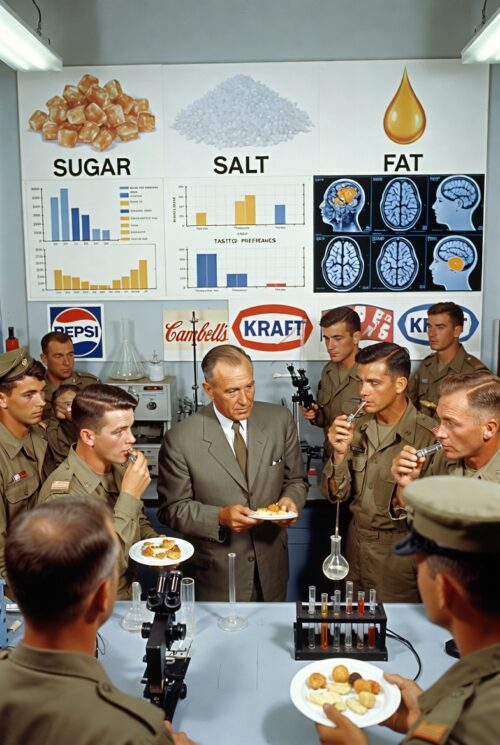
The bliss point was developed out of rigorous testing done on Army soldiers in the late 1960s. The Army hired a man by the name of Howard Moskowitz, a psychophysicist.
What is that?. Here’s the definition: “Psychophysics is the field of psychology that quantitatively investigates the relationship between physical stimuli and the sensations and perceptions they produce. Psychophysics has been described as “the scientific study of the relation between stimulus and sensation” or, more completely, as “the analysis of perceptual processes by studying the effect on a subject’s experience or behavior of systematically varying the properties of a stimulus along one or more physical dimensions.”
The Army hired Howard to get soldiers to eat more. They tossed out their C-rations often, leading to a lot of waste and, in turn, malnutrition for soldiers. So he tested on troops what the perfect combo of fats, sugar, salts, flavor, mouth feel, was the most compelling to consume more. And it worked. Creating addictive meals that spiked intake by 40%. And the Army gave him a gold medal.
- Here’s the Army documents for the research – https://apps.dtic.mil/sti/tr/pdf/AD0753945.pdf
“The food preferences of 8000 military men were analyzed by survey techniques. The results indicate a consistency of preference across military men over a seven-year period, and provide new data for the measurement of food acceptance.”
Check out the Pine Bluff Arsenal paper. The article dives into how terrible sugar is for us, and the man who engineered it, testing it on our military.
Pine Bluff Arsenal – https://media-cdn.dvidshub.net/pubs/pdf_63630.pdf
Sold to the Food Industry for Profit
What did this hero do next? Sold the playbook to Pepsi, Campbells, and Kraft.
They engineered food to increase sales. Prego pasta sauce saw an increase in sales by 30%.
Studies now link these engineered foods to 500 extra calories per day and a 58% higher risk of obesity. It started as a military solution but became a tool for the food industry to make billions. At our expense.
The 500 extra calories per day come from a 2019 randomized controlled trial by NIH researchers, published in Cell Metabolism.
In the study, 20 adults ate either ultra-processed or unprocessed meals for two weeks each, with unlimited portions. On the ultra-processed diet, they consumed about 500 more calories daily without realizing it, gaining nearly 2 pounds. The processed foods, high in sugar, fat, salt, and chemical additives, drove the overeating.
A More Concerning Connection. The Future Company of Moskowitz
So soldiers were used as lab rats (not the first time), and Mokowitz profited off them. Following his time working on this, he founded his own consulting firm, Moskowitz Jacobs Inc. (now part of a larger, more concerning group). He used the bliss point techniques he developed for the military to consult for major food companies, including PepsiCo, Campbell’s, Kraft, and General Foods.
This work involved testing and optimizing products for maximum appeal, which generated substantial revenue for his firm through contracts and product development projects. (i.e., his spaghetti sauce research for Campbell’s in the 1980s). Directly boosting sales and his consulting fees. Over his career, he has authored books and papers on these methods, further monetizing the approach in the food and marketing industries.
Moskowitz Jacobs Inc. was active from 1981 until around 2014, when Howard Moskowitz founded a successor firm called Mind Genomics Associates, Inc., based in White Plains, New York. This new entity focuses on advancing his mind genomics research and consulting in psychophysics and consumer preferences, effectively continuing the work of the original company. This is the more concerning group discussed earlier. His methods have been turned into a larger scale.
Mind Genomics Associates, Inc., continues Howard Moskowitz’s broader work in psychophysics and consumer preferences, which originated from his food industry consulting. The firm applies “mind genomics, an experimental method using surveys, data segmentation, and response analysis, to study everyday decisions and attitudes across topics like food consumption, health behaviors, and social issues.
Mind Genomics has expanded to non-food areas, such as public health messaging, radicalization studies, and marketing in general. Much of it appears to be academic research or implemented for public policy. With little evidence of selling this research to companies, although the firm’s broader work involves consulting for marketing and product development, using the same method to segment consumer preferences for clients in areas like retail, healthcare, and branding.
Public records and publications do not provide a detailed or current list of Mind Genomics Associates’ biggest customers, as the firm “focuses on proprietary consulting” and does not publicly disclose client names in most cases. Their work often appears in academic papers or general case studies without naming specifics.
Consulting for Food Industry, Pharma, Beauty Products.
However, Howard Moskowitz’s broader consulting career (including through Moskowitz Jacobs and Mind Genomics) has involved major global companies across food, pharma, and consumer goods. Known examples from his documented projects include:
- PepsiCo (soda optimization),
- Campbell’s (Prego sauce variants),
- Kraft/General Foods (Jell-O and other products),
- Cadbury Schweppes (Dr Pepper flavors in 2004).
- Pharma and Health: Merck, Johnson & Johnson.
- Consumer and Tech: L’Oréal (beauty products),
- Kodak, Citibank, GE.
Hard to ignore the fact that these are some of the most profitable industries, and imagine none of the firm’s “academic research” leaked over into their consulting methods.
Processed Foods and the Brain. Systemic Sabotage.
The methods they use for food are dangerous to our well-being. Quite literally hijacking the reward system, like drugs, gambling, or alcohol. And with most of these addictions, it can irreparably destroy the ability to create dopamine naturally.
It stimulates the nucleus accumbens, a key hub in the reward circuit, leading to surges in dopamine release that create intense pleasure and cravings.
Over time, repeated exposure can cause down-regulation: the brain reduces its natural dopamine production or receptor sensitivity to maintain balance, making it harder to feel rewarded from everyday activities or healthier foods.
And we don’t have an increase in obesity, depression, and addiction? The hubris to have and not connect the dots between highly addictive food.
When you eat bliss-engineered foods, the rapid breakdown of refined carbs and fats floods the bloodstream, signaling the release of dopamine into the nucleus accumbens. This “hit” feels euphoric but brief, prompting more consumption to chase it.
Unlike whole foods, which release nutrients slowly and sustain satiety, these products are designed for quick peaks without fullness, exploiting the brain’s evolutionary wiring for calorie-dense rewards.
Chronic use leads to neuroadaptations: fewer D2 dopamine receptors (downregulation) and altered prefrontal cortex control, impairing impulse regulation.I specifically spoke of this in the video I made about alcohol doing this exact thing.
And they target kids. Take a look.
Processed Food Companies Target our Children.
Global data on food-specific ad spend to children is sparse, but the industry invests billions overall:
- Total food/soft drink advertising: >$33 billion in 2020, with much aimed at youth via digital channels (social media, influencers).
- Ad spend to children (food context): $7.5 billion in 2021 (digital: $4.6B; non-digital: $2.9B), though this may include broader youth-targeted ads.
- Exposure trends (2024 data): 75% of youth (13–24) across 171 countries saw UPF ads weekly, with 52% via social media. In middle-income countries, 85–99% of analyzed ads promote UPF exceeding WHO nutrient limits.
The generations to come, our children, are set up to fail. And if this doesn’t rip your stomach, then it’s time for a needed reframe on what matters.
Sugar, Processed Foods linked to Heart Disease.
Not only that, as we see sales of billion-dollar industries rise, we see the instances of chronic diseases follow suit. CVD is the number one cause of death in the world. The absolute number of CVD deaths and cases is surging globally, fueled by rising obesity, hypertension, and poor diets.
This trajectory aligns closely with the explosive growth in ultra-processed food (UPF) consumption, which drives food industry profits while exacerbating cardio-metabolic risks.
https://pmc.ncbi.nlm.nih.gov/articles/PMC5099084
Here’s research on the connection between sugar and coronary heart disease.
Phone Addiction Follows Processed Foods Reward System Sabotage.
That silly computer in our hands follows the same tactics. Thanks, social media. You gave billions of people a slot machine in the palm of our hands.
So use it to arm yourself. There is so much information right in your hands. Education on health and what to feed not only ourselves, but our children, is beyond important. And is becoming a priceless skill in a world of illness. And at this point, we need a massive intervention.
Let’s start the conversation – email info@solutions2wellness.org